
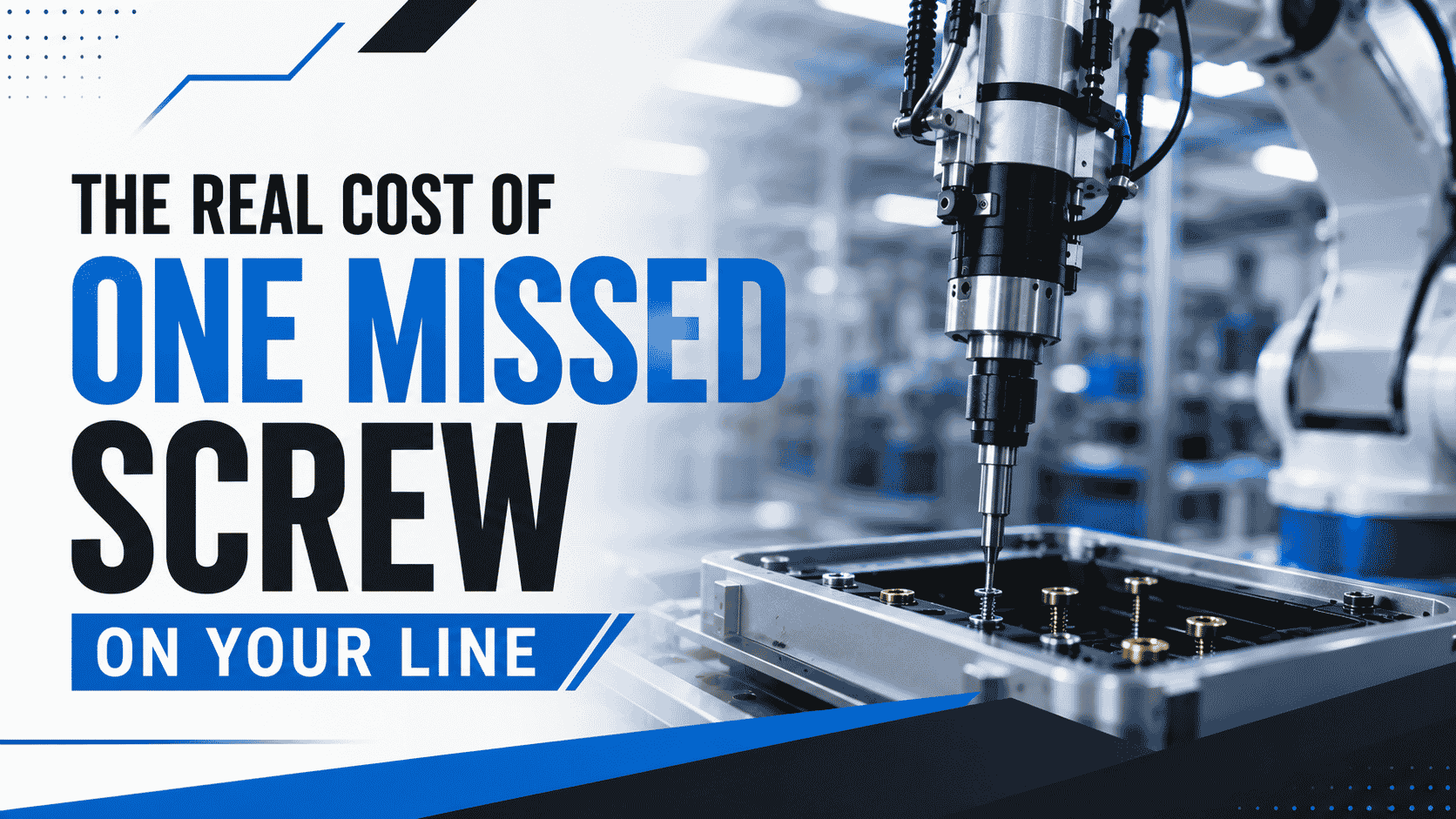
Every plant manager we work with has a version of the same story. A product ships, a few weeks pass, and then a joint works loose in the field — or a whole batch gets pulled over a single fastener that was never fully driven.
That's the trouble with a missed screw: it doesn't announce itself. It passes down the line, gets buried inside a finished unit, and turns up later as a warranty claim you can't easily trace back to a cause.
We've spent years automating fastening for automotive and electronics manufacturers, and this one issue comes up more than almost any other. So let's talk about it honestly.
What a missed screw actually costs
On paper, a screw costs a few rupees. In practice, a bad joint costs you in ways that rarely land on the same report:
- Rework — when someone catches it and has to re-drive it.
- Field failures and warranty claims — when it slips through.
- Customer audits and lost trust — once a pattern shows up.
- A recall, in the worst case — the line item nobody wants to explain.
And here's the uncomfortable part. On a manual line, you usually can't prove a joint was tightened correctly. You can only assume it was.
Why manual fastening keeps failing (it isn't the operators)
Let's be fair about this: it isn't a people problem. It's a process problem.
Fastening quality on a manual line depends on operator attention — and attention isn't a constant. It's sharp at the start of a shift and frays by the end of one. It dips after breaks, varies from person to person, and drops the moment the line speeds up.
Ask anyone to drive dozens of screws a minute, all shift, at a perfect torque, and never miss one. It isn't realistic. We're asking people to behave like machines on exactly the task a machine happens to do better.
What changes with a robotic screw tightening cell
When we replace that operation with a robotic screw tightening system, the point isn't only speed. It's making the correct outcome the only possible outcome — and recording it while it happens.
A well-built cell does a few things a hand-driver simply can't:
- Multi-screw tightening — drives multiple screws in a repeatable sequence, every single cycle.
- Torque & angle monitoring — checks torque and angle on every joint, so an under- or over-torqued screw is caught, not shipped.
- Error-proofing — counts the screws and won't release a part that's missing one. That's the zero-missed-screw target, in practice.
- Vision guidance — finds each screw position even when parts shift in the fixture or variants change down the line.
None of this is exotic anymore. What's changed is that it's now affordable enough to justify on lines people used to write off as too small or too fiddly to automate.
The part most people underestimate: traceability
If I had to name the feature that quietly matters most, it's traceability — and it's usually the one nobody asks about upfront.
Every tightening event — torque, angle, pass or fail, timestamped — can be tied to the individual part and stored. You get a record for each joint, not a general assurance that things went fine.
Two things follow. Your customers stop asking you to prove torque quality, because you can just show them. And when something does go wrong in the field, you can isolate exactly which units and which joints are affected.
That last point is the difference between a targeted action and a blanket recall. Paired with laser marking and track-and-trace, it becomes a continuous digital thread from raw part to finished unit — often worth more than the cycle-time savings that got the cell approved in the first place.
Where we see it pay off
The pattern is consistent across the industries where a loose joint is genuinely dangerous or expensive:
| Where it fits | What it protects |
|---|---|
| Automotive components | Safety-critical joints, recall exposure |
| Consumer electronics | Field reliability, warranty cost |
| Electrical assemblies | Contact integrity and compliance |
| Plastic assemblies & housings | Boss integrity, cosmetic quality |
| Home appliances | Durability and brand reputation |
Across all of them, the wins are the same: shorter cycle time on high-count fastening, consistent torque shift after shift, less dependence on fatigue-prone manual work, and a realistic path to zero missed screws.
What actually makes one of these work
Now the honest part, because we've learned some of this the hard way.
A screwdriver bolted onto a robot is not a solution. The cells that hold up are the ones specified for the real part, integrated properly into the line, validated against your actual torque specs, and — this is the one people forget — supported after the engineers go home.
That's the work we care about at ICA: designing and integrating the whole cell under one roof, tying the fastening data into your wider quality system, and being there for the after-sales stretch when a live line throws a real problem at you. We do it from Chennai and Coimbatore, across FANUC, ABB, Epson, Yaskawa and Omron platforms.
If a customer asked you tomorrow to prove that every screw in last month's shipment was driven to spec — could you?
If that question gives you pause, it's usually the right time to start looking at it. Curious how others are handling fastening traceability on their lines — how are you approaching it?