Automation projects rarely fail because a robot cannot move or a vision camera cannot see. They fail in the spaces between suppliers.
One company supplies the robot. Another builds the fixture. A third writes the PLC logic. A fourth handles the conveyor. A fifth is called when the vision system does not talk to the rest of the cell. Each party can honestly say their piece works. The line as a whole still does not.
That is the gap a true turnkey partner is meant to close. Not by owning every brand of hardware, but by owning the complete engineering responsibility from concept to a running process.
Where multi-vendor projects usually break
The weak points are predictable. Interfaces are underspecified. Cycle-time assumptions made by one supplier are not validated against another’s equipment. Safety circuits are designed late. Change requests during commissioning turn into arguments about whose scope they fall under.
None of this is about bad intent. It is about the structure of the project. When no single engineering team is accountable for the whole sequence — part in, process, part out — the plant ends up managing the integration itself.
What a complete turnkey scope actually covers
A useful turnkey definition is practical, not marketing. It means the same team can take responsibility for the elements that have to work together:
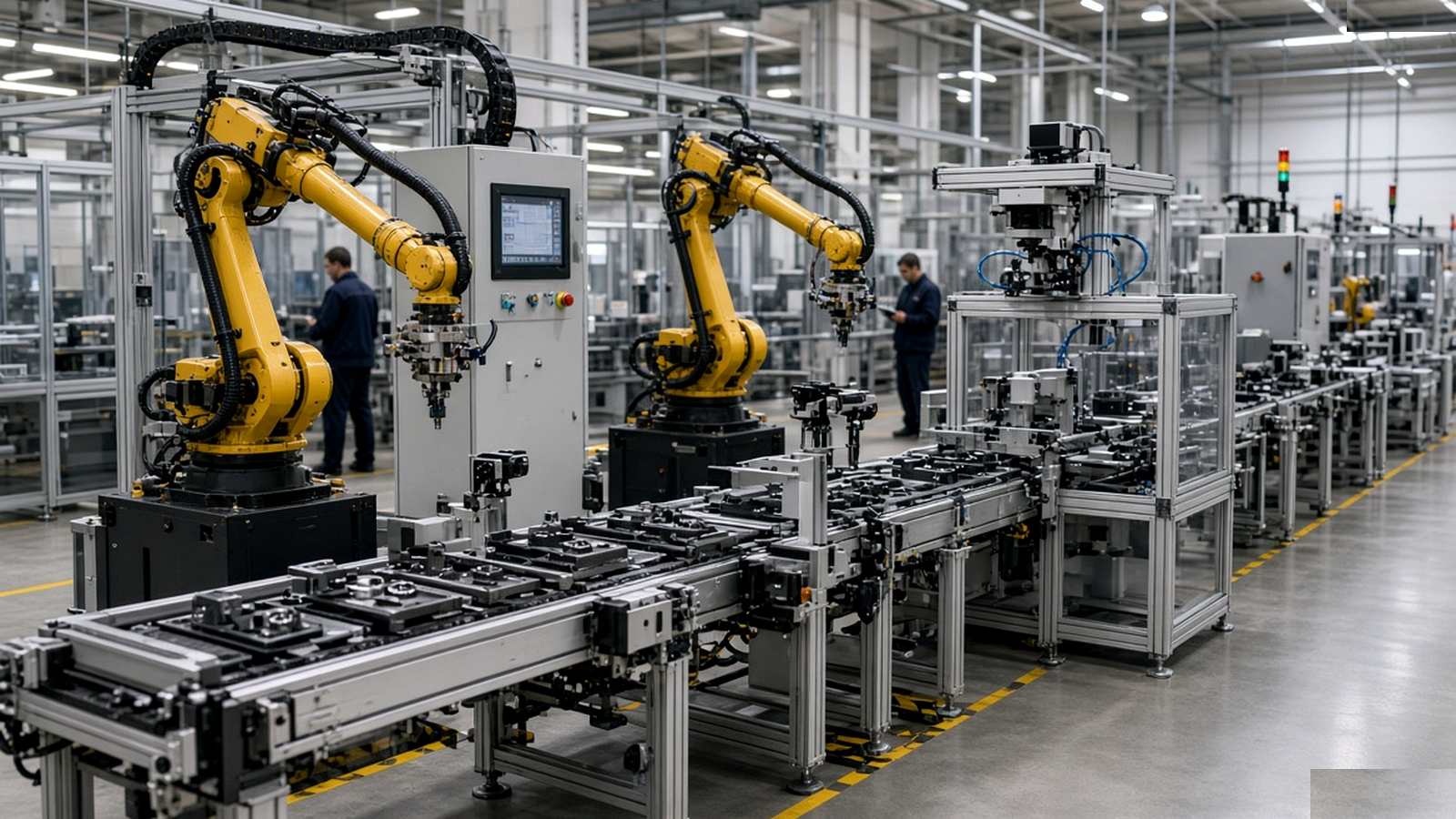
- Assembly and conveyor automation — material flow, buffering and presentation to the process stations
- Gantry and pick & place systems — transfer between stations with the required speed and orientation
- Vision inspection — presence, position, basic quality checks integrated into the sequence, not bolted on later
- Custom EOAT development — grippers, vacuum tools and fixtures designed for the actual part
- PLC & HMI programming — the logic and operator interface that tie the cell into one controllable process
When these are designed together, the interfaces are intentional. Cycle time is a shared target rather than a negotiation. Safety and access for changeover are considered from the first layout, not patched in at the end.
How one engineering team changes the project process
The difference shows up in the sequence of work, not only in the final equipment list.
1. Process understanding before hardware selection
The starting point is the part and the required process — not a catalogue of robots. Cycle time, quality windows, operator access and future variants are clarified first. Hardware is then chosen to serve that process.
2. Integrated mechanical and controls design
Fixtures, EOAT, conveyors and motion systems are designed alongside the PLC and HMI structure. The control logic is not written against a finished mechanical design that no longer matches the real sequence.
3. Build and dry-run under one roof
When the cell is built and initially commissioned by the same team, interface problems surface early — in the workshop, not on the customer’s floor during a compressed start-up window.
4. Site commissioning with clear ownership
On-site work is about connecting the cell to the plant’s power, air and upstream/downstream processes, and proving the agreed performance. It is not the first time the pieces are asked to work together.
The common thread across the processes we have covered
Over recent posts we have walked through robotic screw tightening, soldering, precision dispensing and IMM take-out. Each is a distinct process. The common thread is the same: a cell only delivers its value when the robot, the tooling, the material handling and the controls are designed as one system.
A screw-tightening station that cannot present the part correctly will not hold torque capability. A soldering cell without stable fixturing will not hold joint quality. A dispensing system without path and volume control will not reduce material waste. An IMM take-out robot without the right EOAT and take-away will not recover cycle time.
Turnkey capability is what turns those individual process strengths into a line that runs.
How we deliver this at ICA
ICA designs and builds robotic automation systems for Screwing, Soldering, Dispensing and IMM take-out applications — and the surrounding assembly, conveyor, gantry, vision and controls work that turns stations into complete cells. The engineering, build and commissioning sit with one team operating from our facilities in Chennai and Coimbatore.
You can see the range of solutions on our products page and the robotic automation overview. Vision support is covered under vision systems, and material flow under conveyor systems.
A practical next step
If you are planning a new automation cell, expanding an existing line, or simply trying to close the gaps left by a previous multi-vendor project, the useful starting point is a clear view of the process and the constraints — not a shopping list of robots.
A short consultation can map where the real bottlenecks and quality risks sit, and whether a turnkey approach is the right structure for the next investment. Share a part, a current layout, or a description of the stations that cause the most trouble. That is enough to begin a useful conversation.
One accountable engineering team does not guarantee a perfect project. It does remove the most common reason projects fail: the empty space between vendors.