
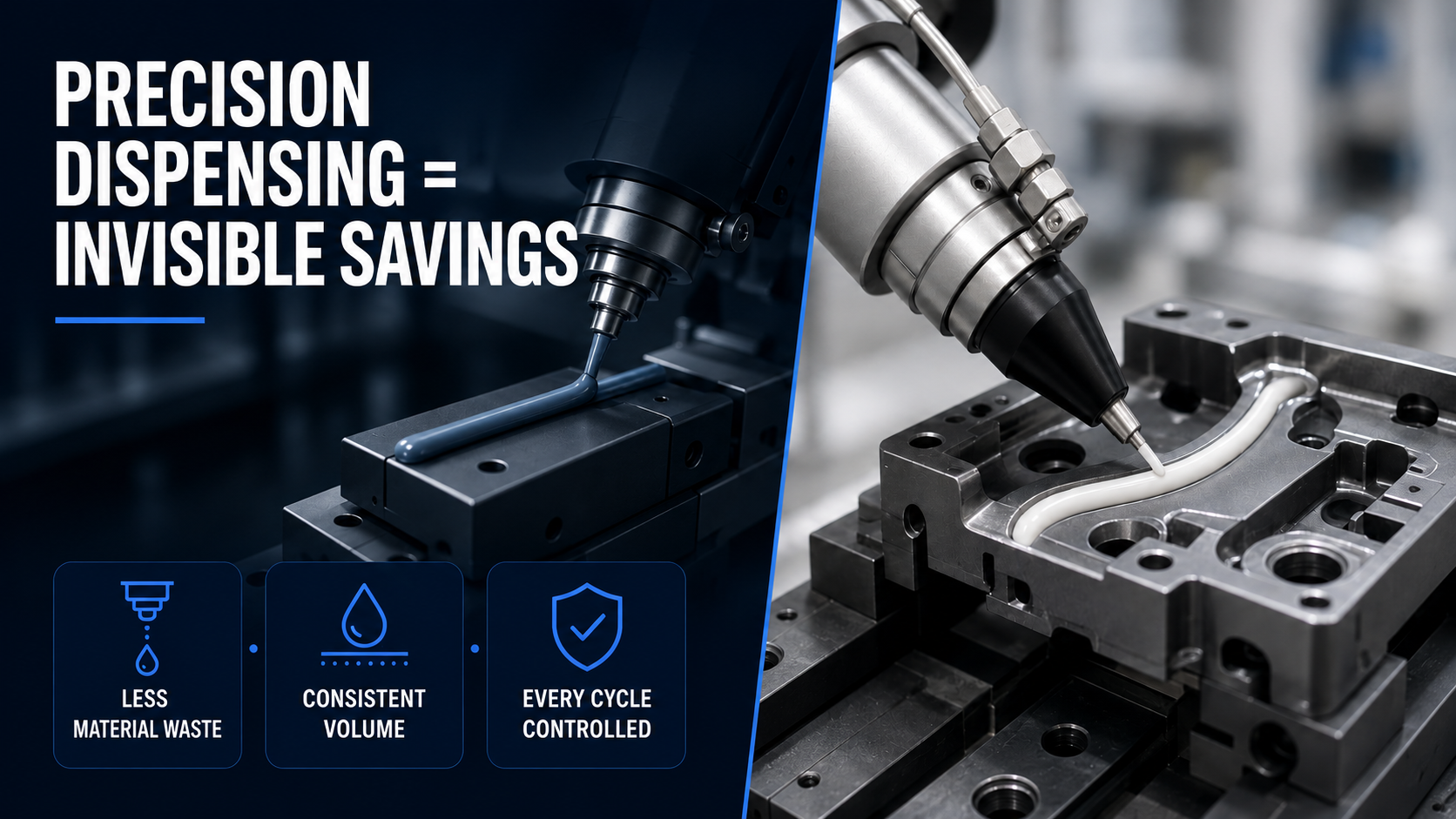
Most factories can tell you their scrap rate, their downtime hours and their labour cost per shift. Far fewer can tell you how much excess grease, sealant or thermal paste they put on parts every day.
That is the nature of over-dispensing. It does not create an obvious defect. The joint still seals. The bearing still gets lubricated. The board still gets potted. The extra material simply disappears into the product — and into the material budget.
Over a year, at production volumes, the difference between “enough” and “a bit more to be safe” becomes a real cost. A robotic dispensing system is one of the few ways to make that cost visible and controllable.
Why over-dispensing stays invisible
Manual dispensing depends on operator feel, gun trigger time and the consistency of the material that day. Even with good training, volume varies. Operators naturally tend to apply slightly more rather than risk an incomplete bead or dry spot. That bias is rational — and expensive when multiplied by hundreds of thousands of cycles.
Semi-automatic systems improve consistency but often still run with fixed time or pressure settings that do not adapt well to viscosity changes or different patterns. The result is the same pattern of modest, continuous over-application that never triggers an alarm.
What a robotic dispensing system actually controls
A modern robotic dispensing cell is built around volumetric control rather than “time and pressure” alone. The robot follows a programmed path. A servo-controlled dispenser meters a precise volume. Patterns can be dots, beads, circles, arcs or complex shapes. Vision can confirm presence and placement where the application is critical.
In practical terms the cell typically manages:
- Volume per shot or per unit length of bead — so the same amount is delivered every cycle
- Path and speed — so the material lands where the drawing requires it
- Multiple recipes — so different products or variants can be selected without re-teaching the whole process
- Optional vision check — so missing or misplaced material is caught before the part moves on
This combination is what turns dispensing from an operator-dependent skill into a process that can be specified, measured and improved.
What happens inside a typical robotic dispensing cell
Like screw tightening or soldering, the value is in the sequence. Here is the journey most parts follow:
1. Part entry and fixturing
The component is presented in a fixture or on a conveyor nest designed so that the dispense points sit in known positions. Stable location is the foundation; without it, even perfect volume control will put material in the wrong place.
2. Presence and position check
Sensors or vision confirm the part is present and correctly seated. This prevents the robot from dispensing into an empty nest or onto a misaligned component — a simple error that wastes material and creates rework.
3. Robot positioning and path execution
The robot moves the dispense nozzle along the programmed path at controlled speed. Paths can be simple dots, continuous beads, circular patterns or multi-segment shapes depending on the application — grease on a bearing, sealant on a housing, thermal paste on a power module, or potting in a cavity.
4. Servo-controlled volumetric dispensing
Material is metered by volume rather than by open-loop time. Servo-driven pumps or positive- displacement valves deliver a repeatable quantity even when viscosity shifts slightly with temperature or batch. This is the core of the material saving: the process no longer needs a safety margin of “extra” to compensate for variation.
5. Optional vision inspection
Where the cost of a missing or incomplete bead is high, a camera can check presence, continuity or approximate volume after dispensing. Rejects are flagged before the part continues downstream.
6. Completed part output
The part leaves the cell with a controlled amount of material in the correct location. Over thousands of cycles the difference versus a manual or time-pressure process becomes measurable in material consumption and in the consistency of the downstream assembly or test results.
Where the savings actually appear
The most obvious saving is material. Grease, anaerobic sealants, silicone, epoxy potting compounds and thermal interface materials are not free. Reducing average volume per part by even a small percentage compounds quickly at production volumes.
Secondary effects matter too. More consistent beads and dots reduce the chance of leaks, dry spots or excess material that interferes with later assembly. Cleaning and rework from over-application drop. Process capability improves because the input to the next station is more uniform.
None of these gains require a dramatic change in cycle time. They come from removing the hidden variability that manual and simple automatic methods leave in the process.
Where robotic dispensing fits best
We typically see the strongest case when:
- The material is relatively expensive or the annual volume is high
- The pattern must be consistent for sealing, lubrication or thermal performance
- Multiple product variants share the same station and need different recipes
- Quality or warranty risk from under- or over-application is significant
Common applications include grease and lubricant on bearings and gears, sealants on housings and covers, potting of electronic modules, thermal paste on power devices, and adhesive beads for assembly.
How we approach a dispensing cell at ICA
A robotic dispensing system is only as good as its integration with the part and the material. We design the fixture, select the robot and dispense valve for the viscosity and volume range, program the paths and volumes, and add vision where it protects quality. The same team designs, builds and commissions the cell from our facilities in Chennai and Coimbatore.
ICA designs and builds robotic automation systems for Screwing, Soldering and Dispensing applications. You can explore related solutions on our robotic automation page and the broader products overview.
A practical next step
If material consumption on a grease, sealant, potting or thermal-paste station feels higher than it should be, or if quality varies between operators, the useful starting point is a look at the actual process — not a brochure.
A short dispensing audit can estimate how much material is being applied versus how much the design requires, and whether a robotic dispensing cell would recover that difference with acceptable payback. Share a part, a current process description, or simply the material and annual volume. That is enough to start a useful conversation.
The savings are often already sitting on the line. They just have not been measured yet.