Injection moulding is a numbers game. A two-second reduction in cycle time does not look dramatic on a single shot. Multiplied across shifts and months it becomes thousands of extra parts — or the difference between a press that is fully utilised and one that is waiting on the next manual extraction.
Manual take-out keeps an operator tied to the machine. It introduces variation in timing, limits how close the process can run to the theoretical minimum cycle, and creates repetitive reach and heat exposure. An IMM take-out robot removes that bottleneck. The robot is ready the moment the mould opens, extracts with consistent motion, and places the part for the next step — conveyor, stacker, inspection or secondary operation.
The value is not only speed. It is repeatable extraction, higher machine utilisation and a safer cell.
Why a few seconds matter so much
Cycle time in injection moulding is the sum of injection, packing, cooling and the time required to open, extract and close again. The extraction window is often the part that still depends on a person. When that person is slightly late, or needs a moment to clear a part, the entire cycle stretches.
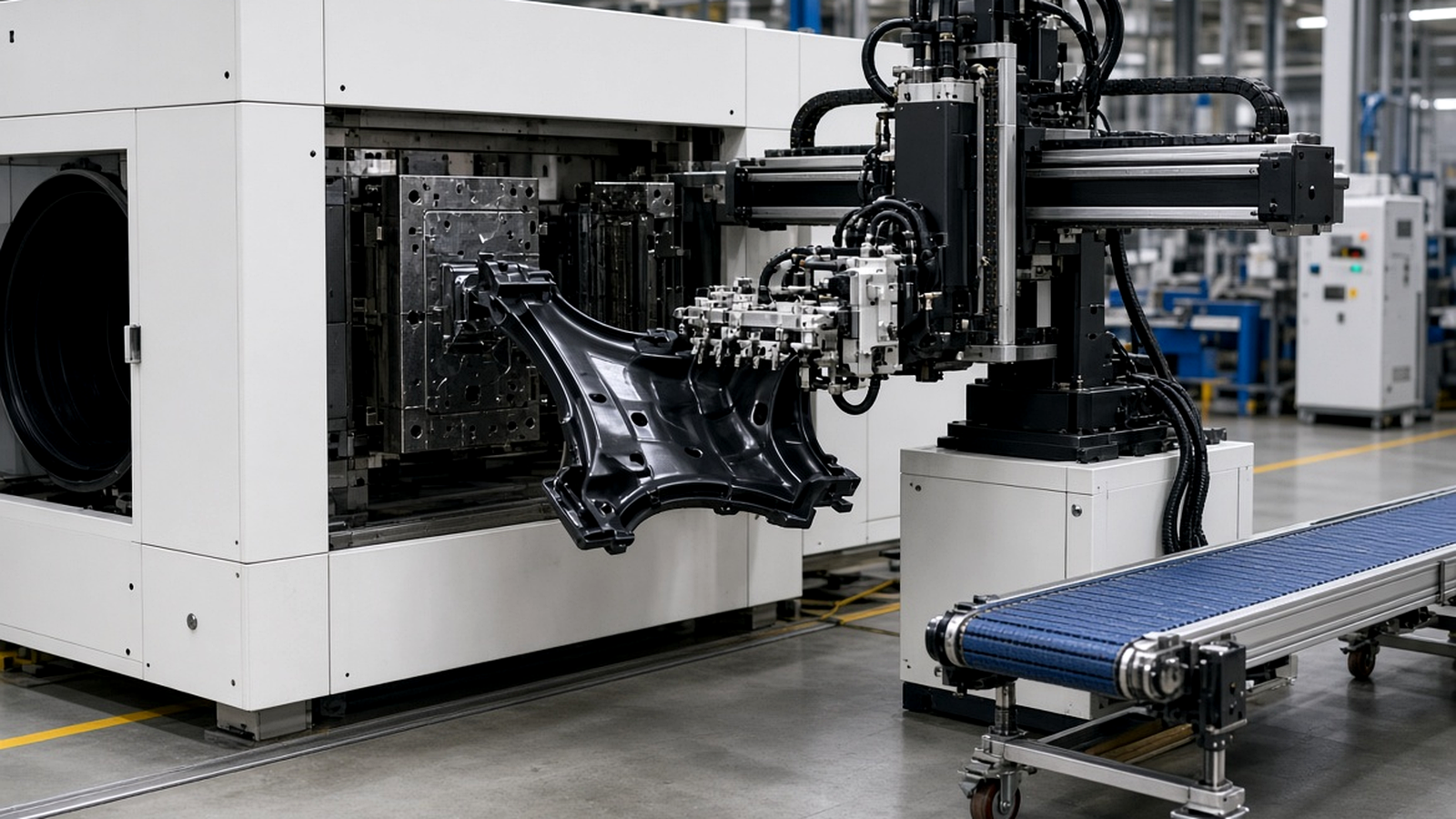
A servo-driven IMM take-out robot is available at the exact moment the mould opens. It follows a taught path at controlled speed, grips with custom EOAT designed for the part, and clears the mould area so the press can close again without waiting. Over a month of continuous production those recovered seconds become measurable output and better utilisation of an expensive machine.
What happens in a typical IMM take-out sequence
The robot does not simply “pick the part”. The sequence is timed to the press and designed around the mould and the downstream process.
1. Mould open signal
The injection moulding machine signals that the mould is open and the part is ready. The robot is already in a waiting position close to the mould so that travel time is minimised.
2. High-speed entry and approach
The robot moves into the mould area on a programmed path. 3-axis systems cover the majority of standard take-out paths with high speed and simplicity. 5-axis systems add orientation capability for complex parts, undercuts or placements that require the part to be rotated before it leaves the mould or reaches the next station.
3. Grip with custom EOAT
End-of-arm tooling is designed for the specific part — vacuum cups, mechanical grippers, or combinations that hold the part securely without marking critical surfaces. Good EOAT design is as important as the robot itself; it determines whether the part is extracted cleanly and presented correctly for the next step.
4. Extraction and clear
The robot withdraws the part on a path that avoids the mould halves and any cores or slides. Once the part is clear, the press can begin closing. The robot does not linger in the mould area.
5. Place, stack, convey or inspect
Depending on the cell design, the robot places the part on a conveyor, into a stacker, onto a fixture for secondary operations, or under a vision system for basic inspection. Integration options turn a simple take-out into a short automated sequence that reduces handling further downstream.
6. Return and wait
The robot returns to its ready position and waits for the next mould-open signal. The cycle repeats with the same timing and the same motion path, shift after shift.
What plants typically gain
When the robot and EOAT are matched to the press and the part, the usual results are:
- Reduced cycle time — extraction no longer waits on an operator
- Higher machine utilisation — the press spends more time moulding and less time waiting
- Safer operations — operators are removed from the immediate mould area and from repetitive reaching into a hot press
- Lower operator dependency — one person can oversee more machines because take-out is no longer a continuous manual task
These gains are largest on high-volume or multi-cavity tools where every second is multiplied by the number of parts per shot and the number of shots per day.
3-axis and 5-axis: choosing the right robot
A 3-axis IMM take-out robot is the workhorse for many standard extraction paths. It is fast, compact and cost-effective when the part can be removed and placed with linear motion.
A 5-axis system adds wrist orientation. It is the better choice when the part must be rotated for placement, when the mould geometry requires a more complex exit path, or when the next station needs the part presented in a specific orientation. The extra axes cost more but often pay for themselves by eliminating secondary handling or enabling a cleaner cell layout.
The right choice depends on the part, the mould and the downstream process — not on a general preference for more axes.
Turnkey cells, not just a robot on a press
An IMM take-out robot delivers the most value when it is integrated with the rest of the cell. Conveyor take-away, stacking, basic inspection, and guarding that allows safe access for mould changes all matter. A turnkey approach designs the robot, EOAT, peripheral equipment and safety around the actual machine and the actual part.
At ICA we design and build these cells from our facilities in Chennai and Coimbatore. The same team that specifies the robot also designs the EOAT, integrates conveyors or stackers where needed, and commissions the sequence on the press. ICA designs and builds robotic automation systems for Screwing, Soldering, Dispensing and IMM take-out applications.
You can explore related solutions on our robotic automation page and the broader products overview.
A practical next step
If cycle time is limited by manual take-out, if operators are tied to the press, or if you are planning a new tool and want extraction designed in from the start, the useful conversation starts with the machine, the mould and the part.
Our teams in Chennai and Coimbatore can assess a setup on-site. Share the IMM size, a sample part or a short description of the current extraction method. That is enough to discuss whether a 3-axis or 5-axis take-out robot, with the right EOAT and peripherals, will recover the seconds that are currently being left on the table.
Seconds saved per cycle become thousands of parts gained over the life of the tool.