
Most plant managers don’t wake up one morning and decide to automate. The decision usually builds quietly over months of the same problems repeating.
On plant visits we keep hearing the same underlying questions: “Is this just how the work is?” or “Have we reached the limit of what people can consistently deliver on this process?” The answer is rarely black and white. But certain patterns appear so often that they have become reliable signals.
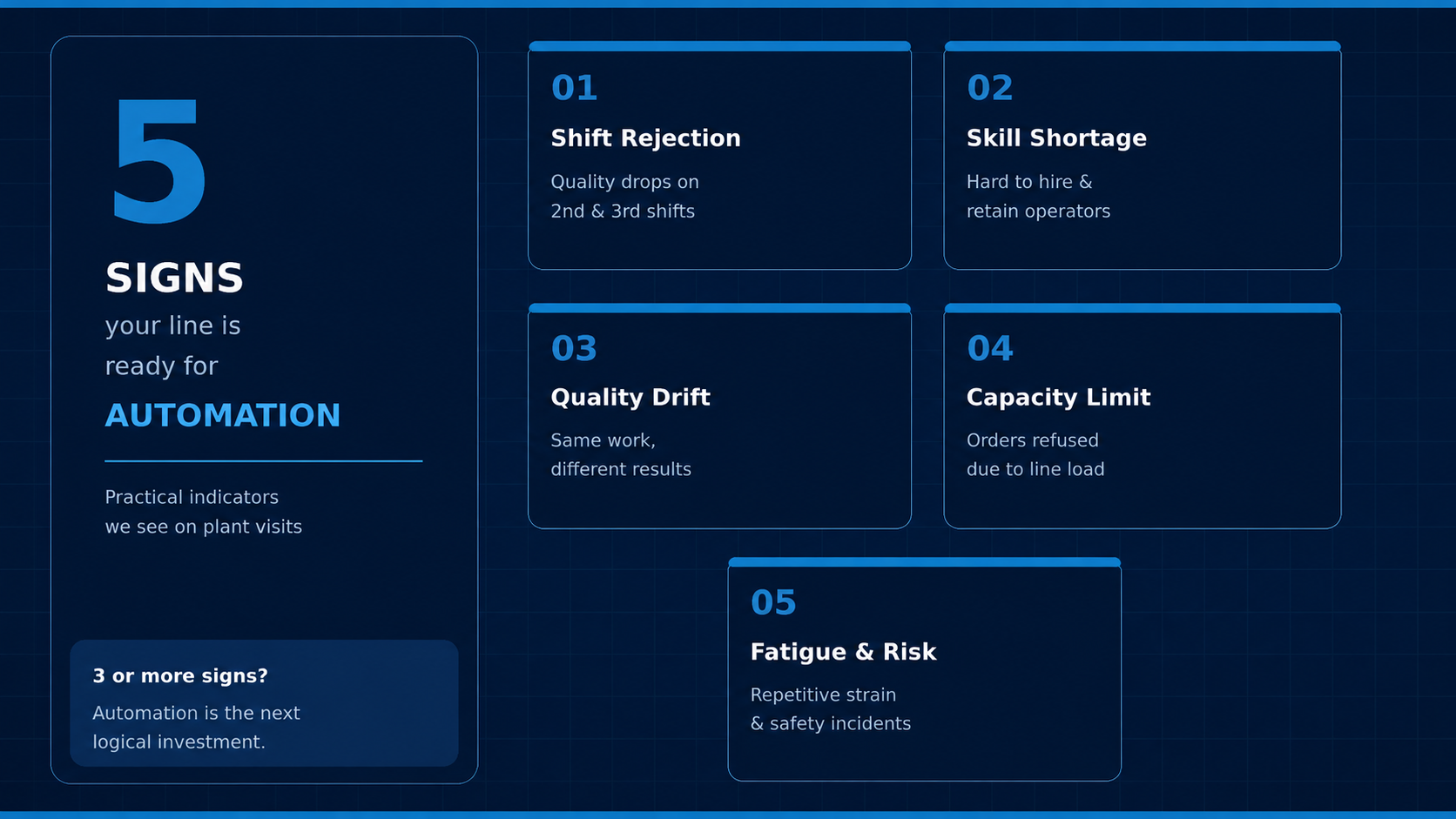
Here are five signs we see repeatedly. None of them alone proves that a robot is the right answer. Together, they usually mean it is time to look carefully at the process.
1. Rejection rates creep up during second and third shifts
First-shift quality is often the benchmark. By the time the second and third shifts are running, the same process starts producing more defects — missed screws, incomplete solder joints, inconsistent dispense volumes, or parts that fail final inspection.
This is rarely about people “not caring”. It is about fatigue, reduced supervision, and the natural variation that appears when a process depends heavily on individual skill and attention over long hours. When rejection rates move with the shift, the process is telling you it is sensitive to human variation.
A well-designed automation cell does not get tired at 2 a.m. The same torque window, the same temperature, the same motion path and the same inspection criteria run on every shift.
2. Skilled operators are hard to hire and harder to retain
Many of the processes that still run manually — precision screw driving, selective soldering, consistent dispensing — require people who have developed a feel for the work. Those people are increasingly difficult to find, and once trained they are often recruited away or move to less repetitive roles.
When a line depends on a small group of highly skilled operators, quality and output become fragile. One resignation or one extended leave can expose how much process knowledge was sitting in people’s hands rather than in the process itself.
Automation does not remove the need for skilled people. It moves their skill from repeating the same motion thousands of times to supervising, improving and troubleshooting a stable process.
3. Quality varies between shifts doing identical work
Two operators, same fixture, same components, same work instruction — yet the results are not the same. One shift runs clean; another produces a higher percentage of borderline or failed parts.
This is one of the clearest signals that the process window is too dependent on individual technique. In screw tightening it shows up as torque scatter. In soldering it shows up as joint appearance and reliability. In dispensing it shows up as volume or placement variation.
When the same work produces different quality depending on who is doing it, the process is a strong candidate for controlled automation.
4. You are refusing orders because the line is at capacity
Capacity constraints are not always dramatic. Sometimes the line simply cannot take another product variant or another volume increase without adding people or shifts that are hard to staff reliably.
When commercial opportunities are being declined because the current process cannot scale, the cost of inaction is no longer just internal inefficiency — it is lost revenue. In those cases the ROI conversation changes. Automation is no longer only about cost per part; it is about protecting or growing the order book.
5. Repetitive tasks are causing operator fatigue and safety incidents
Highly repetitive motions — reaching, twisting, applying consistent force, maintaining awkward postures — accumulate strain. Over time this shows up as fatigue, slower cycle times late in the shift, higher error rates, and in some cases reportable incidents or compensation claims.
Automating the most repetitive and force-sensitive parts of the job protects people while protecting the process. The operators who remain can focus on higher-value work: changeovers, quality oversight, and continuous improvement.
What these signs mean when they appear together
One of these signs in isolation can often be managed with better training, clearer work instructions or improved fixtures. When three or more appear on the same line, the underlying issue is usually structural: the process is asking people to deliver a level of consistency and endurance that is difficult to sustain.
That is the point at which a focused automation assessment becomes useful. Not a full factory redesign — a practical look at the specific stations where variation, capacity or fatigue is concentrated.
What a short plant assessment usually examines
A useful assessment is specific. It typically looks at:
- Which stations show the highest quality variation between shifts or operators
- Where cycle time or capacity is the real constraint
- Which tasks are most repetitive or physically demanding
- How much of the current quality window depends on individual skill versus process control
- What a realistic first automation cell would need to deliver to justify itself
From there it becomes clearer whether the next step is a robotic screw-tightening cell, a soldering cell, a dispensing station, or a broader multi-station solution.
You can see examples of how we approach these processes on our robotic automation page and the wider products overview.
A practical next step
If three or more of the signs above sound familiar on your line, the useful next conversation is not about robots in general. It is about the specific process that is generating the most variation, capacity pressure or fatigue.
A short plant assessment can usually identify where the clearest ROI sits — and whether automation is the right response, or whether fixture, process or training improvements should come first.
That conversation starts with the actual station and the actual data, not with a product catalogue.