
In many assembly processes the bond line is invisible once the parts are together. That makes it easy to treat adhesive application as a secondary operation — something that just needs to “get enough material on” so the joint holds.
The reality is stricter. A thin or broken bead creates a weak path that can fail under vibration, temperature cycling or load. An excessive bead wastes material, can interfere with fit, and still does not guarantee strength if the path is wrong. Manual or simple time-pressure application leaves both risks open because volume and path vary with the operator and the shift.
A robotic adhesive application cell closes that gap. It treats the bead as a controlled process variable rather than a skill-dependent step.
Why bead consistency matters more than raw speed
Faster cycle times only help if the joint is reliable. When bonds fail in the field or at final test, the cost is rework, scrap, warranty exposure and lost trust. The plants that gain the most from robotic adhesive systems are usually those that first stabilise the bead — and then raise throughput on a process they can trust.
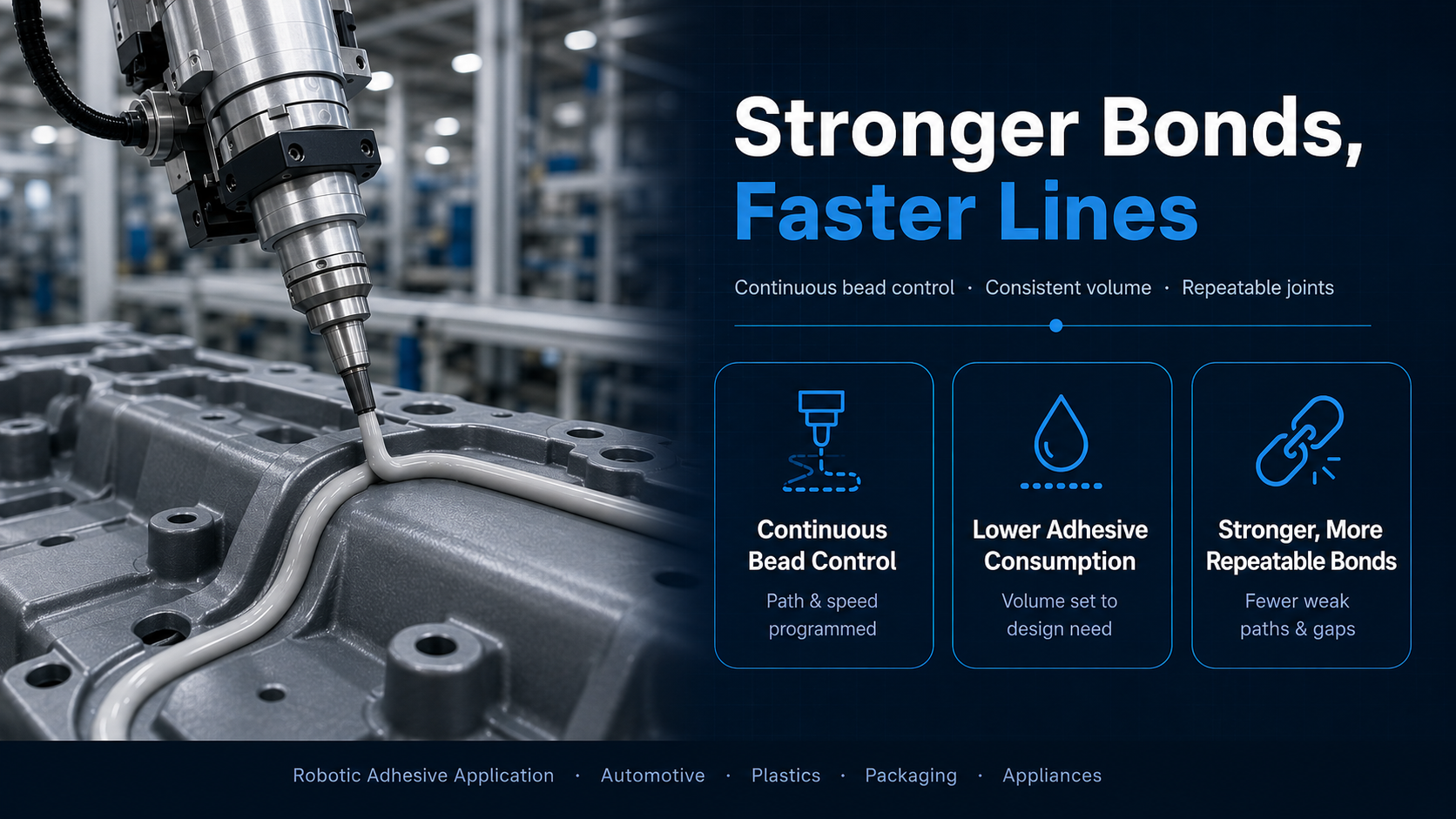
Continuous bead control and flexible path programming are the two levers that make this possible. The robot follows a taught or offline-programmed path at controlled speed. The dispenser meters volume so the cross-section of the bead stays inside the process window. Recipes can be stored for different parts so changeover does not mean reinventing the process.
What happens inside a robotic adhesive application cell
The sequence is deliberate. Each step exists to protect bond quality and material use.
1. Part entry and location
The component is presented in a fixture or nest designed so that the bond path sits in a known position relative to the robot. Accurate location is non-negotiable. If the part can shift, even a perfect volume will land off the intended land area.
2. Presence and readiness check
Sensors or vision confirm the part is present, correctly oriented and ready for adhesive. This prevents dispensing into an empty nest or onto a part that is not prepared — a simple error that wastes adhesive and creates downstream problems.
3. Path execution by the robot
The robot moves the dispense nozzle along the programmed path. Paths can be continuous beads, segmented lines, closed loops or complex 3D contours depending on the joint design. Speed is controlled so the bead geometry stays consistent even on curves and corners.
4. Automatic mixing, dosing and volumetric control
For single-component adhesives the system meters a set volume. For two-component materials, automatic mixing and dosing keep the ratio correct and the mixed material fresh. Servo-controlled or positive-displacement dispensing reduces the variation that time-pressure systems introduce when viscosity changes with temperature or batch. The result is a bead whose volume and shape stay inside the design window cycle after cycle.
5. Optional inspection and safety
Where bond integrity is critical, vision can check bead presence, continuity or approximate width after application. Integrated safety enclosures protect operators while allowing the cell to run at production rates. Fume or vapour extraction is added when the adhesive chemistry requires it.
6. Completed assembly output
The part leaves the cell with a controlled bead in the correct location, ready for joining, curing or the next station. Because volume and path are process parameters rather than operator judgement, the bond strength distribution tightens and material consumption becomes predictable.
What plants typically gain
When the cell is specified against the real part and adhesive, the usual outcomes are:
- Stronger, more consistent bonds — fewer weak paths caused by thin or broken beads
- Lower adhesive consumption — volume is set to the design requirement instead of a generous “to be safe” margin
- Faster, more stable lines — cycle time can be raised once quality no longer depends on the slowest or most careful operator
- Easier changeover — stored recipes for different parts reduce the time and risk of switching products
These gains compound on high-volume automotive parts, plastic assemblies, packaging components and appliance manufacturing, where the same joint is made tens or hundreds of thousands of times.
Where robotic adhesive systems fit best
The strongest cases usually share a few traits:
- The bond is structural or sealing-critical
- Annual volume is high enough for material and quality savings to matter
- Path geometry is more complex than a simple straight bead
- Multiple variants share the same station and need different paths or volumes
Typical applications include body and chassis bonding in automotive, plastic housing and cover assembly, packaging seals, and appliance structural or sealing joints.
How we approach the cell at ICA
A robotic adhesive applying system succeeds or fails on the details of the part, the adhesive chemistry and the required cycle. We design the fixture, select the robot and dispense technology for the viscosity and volume range, program the paths, integrate mixing and dosing where needed, and add safety and inspection as the risk profile demands. The same team designs, builds and commissions from our facilities in Chennai and Coimbatore.
ICA designs and builds robotic automation systems for Screwing, Soldering and Dispensing applications — including precision adhesive bonding. You can explore related solutions on our robotic automation page and the broader products overview.
A practical next step
If bond quality varies between shifts, adhesive consumption feels high, or the current process is limiting line speed, the useful starting point is the actual part and the current bead — not a general discussion about robots.
Share a component, a drawing of the bond path, or a short description of the failures you are seeing. Our engineering team designs around the exact part and can tell you honestly whether a robotic adhesive cell is the right response and what the process would look like.
Stronger bonds and faster lines come from the same place: a bead you can specify, measure and repeat.